
As a patient, when you need a dentist, you usually refer to attending a dental appointment to improve your oral hygiene, clean your teeth, treat a carious cavity, repair a fractured or damaged filling, or provide a crown. You may also need a bridge to replace a missing tooth, or you may be concerned about bleeding gums due to gum inflammation. At times, you might be suffering from toothache and require root canal treatment.
However, there are situations where the nature of the gum problem is more advanced, with increased extent and severity of gum disease. In such cases, you may be advised to see a periodontist.
It is paramount to understand the difference between the role of a general dentist and a periodontist in diagnosing gum problems, gum disease, and the supporting structures around the teeth, in order to establish the correct diagnosis and the most appropriate treatment approach for achieving healthy gums.
The following guide will describe the role of each profession: the dentist, and the specialist periodontist, who has undertaken extensive advanced training in all aspects of gum health, gum disease, periodontal treatment, and the wider medical and systemic health conditions associated with gum disease.
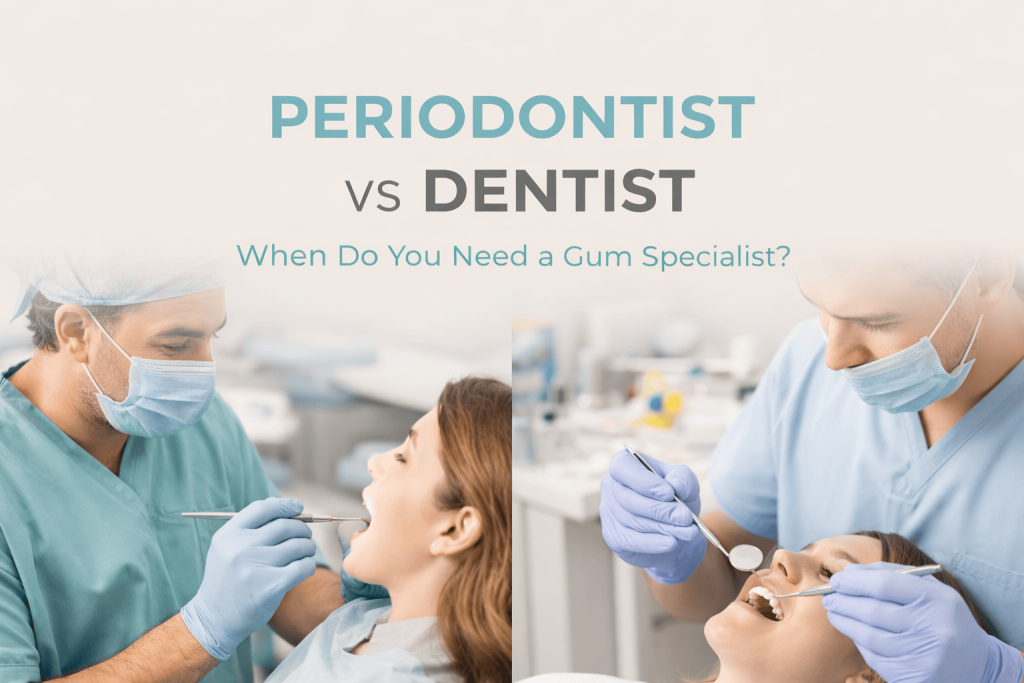
What Does a Dentist Do?
As the main oral healthcare providers, general dentists are trained to diagnose, treat, and manage oral health conditions, as well as to maintain the oral health achieved over time. They manage conditions affecting the teeth and gums to a certain extent.
Dentists typically provide the following services:
- Regular dental check-ups and routine oral examinations
- Professional dental hygiene and cleaning appointments
- Diagnosis and removal of dental decay
- Placement of restorations, mainly fillings
- Provision of crowns and bridges for damaged teeth
- Fabrication and placement of dentures when required
- Basic tooth extractions
- Simple root canal treatments
- Preventive oral healthcare and patient education
- Early identification and basic management of gum disease
What Is a Periodontist?
After several years of practice in general dentistry, some dentists develop a specialist interest in periodontology and pursue additional postgraduate specialist training to gain advanced knowledge and experience in the treatment of the gums, bone, and supporting structures around the teeth, collectively known as the periodontal tissues.
Periodontists are highly trained in oral medicine and have extended knowledge in endodontics and implantology. Their specialist education also includes focused training in orthodontics, prosthodontics, and other related dental subspecialties, with particular emphasis on periodontology and the relationship between systemic health and diseases affecting the tooth-supporting structures, known as the periodontium. As a result, periodontists are able to diagnose and manage more advanced and complex forms of gum disease and conditions associated with periodontal breakdown.
Periodontists are trained and specialised in the following areas:
- Diagnosis and management of early gum disease and gingivitis
- Treatment of advanced gum disease including periodontitis
- Diagnosis and treatment of gum recession and exposed tooth roots
- Assessment, diagnosis, and management of bone loss around teeth
- Identification and treatment of periodontal or pathological pockets caused by gum disease
- Regenerative procedures for gum and bone defects
- Reconstructive periodontal surgery to restore lost supporting tissues
- Gum grafting procedures to correct recession and improve gum thickness
- Crown lengthening and gingival recontouring procedures
- Treatment of gummy smile conditions
- Placement of dental implants
- Diagnosis and management of peri-implant diseases
- Prevention, treatment, and long-term maintenance of periodontal health
- Preservation of natural teeth through advanced periodontal care
When Should You See a Periodontist?
You may wish to seek a referral to a periodontist if you experience any of the following concerns related to your gum health or the supporting tissues around your teeth:
- Persistent bleeding gums despite good oral hygiene and professional cleaning, especially when bleeding continues after hygienist treatment and may indicate underlying gum disease
- Ongoing gum recession with exposed tooth roots, root sensitivity, or noticeable changes in gum appearance, which may require specialist diagnosis and possible gum grafting or gum transplant procedures
- Teeth that are moving or showing signs of pathological tooth migration, often associated with bone loss or weakening of the supporting structures
- Presence of untreated, deepened periodontal pockets that trap bacteria and make effective cleaning difficult, requiring specialist periodontal care
- Persistent gum inflammation or infection that does not resolve despite treatment by a dentist or hygienist
- The need to replace missing teeth with dental implants, where a periodontist is best qualified to assess, plan, and perform implant placement safely and predictably
Understanding Periodontal Disease
In most individuals, gum disease begins as gingivitis. Gingivitis, or gum inflammation, typically presents with redness and swelling. While gingivitis does not always progress to periodontal disease or bone loss, it can usually be effectively treated at an early stage by a hygienist or a dentist.
However, in some patients with underlying systemic conditions, genetic predisposition, compromised immune function, or connective tissue disorders, gingivitis may gradually progress into a more severe disease involving bone and periodontal tissue destruction. In these cases, an infectious inflammatory process can lead to loss of supporting structures such as the gums and bone, resulting in gum recession, bone loss, increased tooth mobility, and potentially tooth loss.
For this reason, it is essential that patients showing early signs and symptoms of gum disease are referred at an early stage to a specialist periodontist for accurate diagnosis, timely intervention, and long-term preservation of oral health.
How Dentists and Periodontists Work Together
A dentist and a periodontist typically work collaboratively throughout the diagnosis, treatment, and long-term management of gum disease. This coordinated approach usually follows these steps:
- The dentist identifies signs of gum disease and provides a referral to a periodontist for specialist assessment
- The periodontist carries out a comprehensive periodontal evaluation, including full periodontal charting, six-point pocket measurements, assessment of bleeding on probing, gum recession, tooth mobility, furcation involvement, and other diagnostic parameters
- The severity and extent of gum disease are assessed, and an accurate prognosis is established
- The periodontist evaluates the patient’s general health and identifies any local or systemic predisposing or risk factors contributing to periodontal disease
- Appropriate treatment is planned and delivered based on whether the gum disease is mild, moderate, or advanced, along with management of any other gum-related conditions
- Following active treatment, a tailored supportive periodontal maintenance and monitoring programme is established
- The patient is then referred back to the general dentist for ongoing comprehensive oral health care, restorative treatment, and routine maintenance
- The patient continues to attend periodic reviews with the periodontist, typically at least once a year, to monitor stability and prevent recurrence of periodontal disease
Clinical Perspective
Dr. Nico Kamosi completed his recognised specialist training in periodontology at the Eastman Dental University in 2000. Since then, he has continued to advance his education in oral implantology, prosthodontics, and orthodontics. In line with his Scandinavian training as a Doctor of Dental Surgery, he strongly believes in prevention rather than correction.
He follows a traditional, principled approach that emphasises early diagnosis and prevention, careful and thorough assessment, and precise diagnosis. His philosophy is centred on providing individualised periodontal treatment planning for each patient, with the aim of preserving as many natural teeth as possible for as long as possible. Through non-invasive, atraumatic, and regenerative treatment approaches, he focuses on improving and maintaining the health and integrity of the periodontal supporting structures.
Learn more about periodontal treatment and a detailed overview of periodontal care, specialist treatments, and how gum health supports long-term oral function.
Questions or Considering Specialist Care?
If you have bleeding gums, gum recession, loose teeth, or have been advised to see a specialist, you can arrange a consultation here.

Dr. Nico Kamosi

Dr. Nico Kamosi
Specialist Periodontist, Implantologist, Prosthodontist, Holistic and Biological Dentist
TDL. DDS. (Swe.), MSc.Perio.(Eng.),
MClinDent.Perio.(Eng.), MSc.Imp.Dent.(Eng.),
Dip.Aesth.Med. (Eng.), MClinDent.Prosth.(Eng.),
Cert., Dip.DHSLM.(RCS.Eng.), Cert.Orth.(Eng.), Cert.Law (Eng.), AIAOMT
Accredited member of IAOMT, SMART Certified
Member of AACD, EFP, AAP, ESCI, IAOMT
