
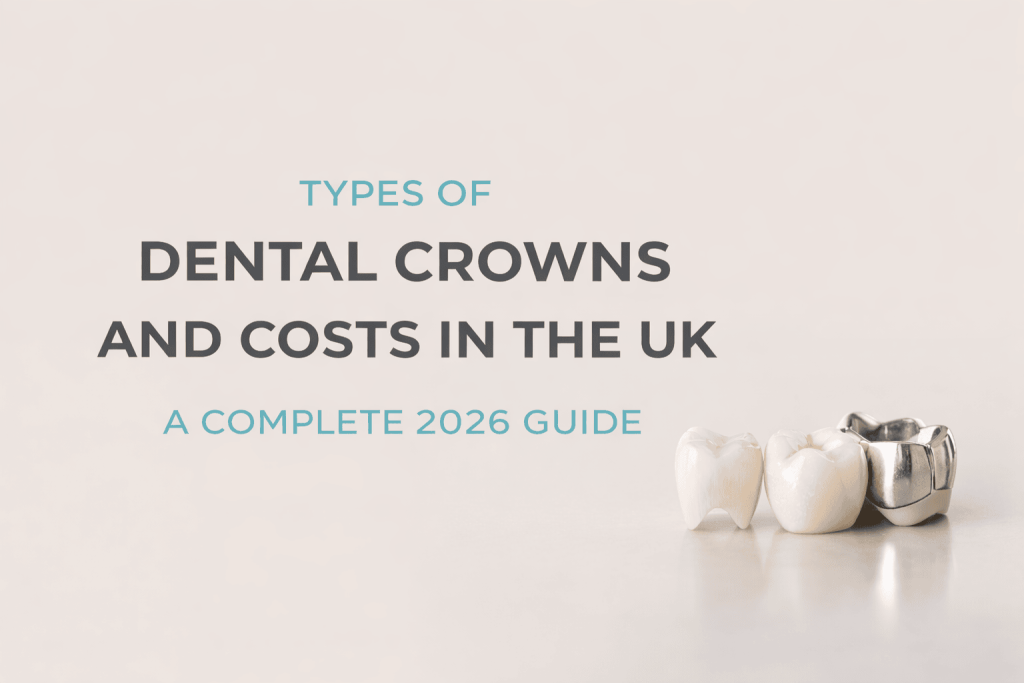
In recent years, there have been significant advances in ceramic and zirconia materials. These developments have greatly improved the quality and clinical performance of dental crowns, making them suitable for use in posterior regions of the mouth. Modern ceramic and zirconia crowns offer increased strength, durability, and a highly natural appearance, allowing them to be used successfully in the majority of clinical situations.
This guide explains the most commonly used types of dental crowns in the UK, how they differ, and what patients can expect in terms of costs in 2026, based on current clinical practice.
What Is a Dental Crown?
Dental crowns are among the most common indirect dental restorations. They are used to protect weakened or heavily compromised teeth, including teeth that have undergone root canal treatment, fractured teeth, and teeth with very little remaining tooth structure. The primary purpose of a dental crown is to protect the remaining tooth substance, improve the appearance of the tooth, and restore normal function.
If you visit your dentist because a tooth is deeply damaged or severely disintegrated and requires treatment, it is important to understand that a dental crown is usually advised in certain situations to protect the tooth.
A dental crown is recommended when the tooth is fractured or significantly disintegrated, when it is supported by multiple small fillings or failing, weakened fillings, or when there is a very large decay or structural defect. Crowns are also advised when most of the functional part of the tooth has fractured and the remaining structure is no longer strong enough to function safely on its own.
A crown is commonly required for teeth that have undergone root canal treatment due to infection, as these teeth are more fragile and need additional protection. In some cases, a tooth may also need to be crowned in order to support a dental bridge when there are no other suitable options available and dental implants are not an appropriate choice for the patient.
Common Types of Dental Crowns
The requirement for our new generation of the dental materials or. Then told us trading materials. Are a combination of aesthetic, appearance and durability strengths. This has been offered by Tooth Coloured. Metal tree. Materials mainly. On the following. Crowns mosly offered by modern UK clinics:
Ceramic (Porcelain) Crowns
Ceramic (porcelain) crowns have historically been a material of choice when aesthetics have been the main priority for both patients and dentists. They are particularly effective for improving the appearance of teeth. However, traditional porcelain crowns may lack sufficient strength when used in the posterior regions of the mouth.
The key characteristics of porcelain crowns include the ability to achieve excellent aesthetic results through advanced layering techniques. This allows the dental technician to closely replicate the natural appearance of teeth. The translucency of porcelain can be modified and adjusted to match the original tooth as well as the neighbouring teeth, creating a highly natural result.
As there is no metal component involved in the construction of porcelain crowns, this material is suitable for patients who present with metal sensitivities or who prefer metal free restorations.
Common uses
Porcelain crowns are most commonly used in the anterior region of the mouth, where aesthetics are of paramount importance and functional load is lower.
Typical UK cost (2026)
From £1,050–£1,200
E-Max™ (Lithium Disilicate) Crowns
E.max crowns, inlays, and bridges represent a new generation of ceramic restorations that have largely replaced traditional porcelain materials. This is because they offer both clinicians and patients a combination of high durability, high strength, and excellent aesthetics.
These restorations require a more conservative tooth preparation, meaning less damage to the original tooth structure while still providing outstanding aesthetic results, long term durability, and resistance to fracture. The reduced need for aggressive tooth reduction helps lower the risk of structural failure over time.
E.max crowns are among the most commonly used restorations in modern dental clinics, as they successfully combine strength and aesthetics in a wide range of clinical situations.
Key characteristics include improved mechanical strength and flexibility, with significantly higher flexural strength and fracture resistance compared to traditional porcelain. They provide excellent clinical aesthetic outcomes and are compatible with increased biting forces, making them suitable for both anterior and selected posterior applications.
Common uses
Both in the anterior and posterior teeth, the choice is based on the amount of remaining tooth substance.
Typical UK cost (2026)
From £1,050
Zirconia Crowns
The new generation of dental materials has offered dentists one of the most resistant, durable, and reliable options for crowns and bridges: zirconia. Zirconia crowns and bridges provide exceptional strength and long-term durability. In recent years, their aesthetic qualities have also improved significantly, making them comparable to ceramic reinforced crowns in terms of appearance, even in the anterior region.
This has been achieved through advanced layering techniques and the development of multi layered zirconia. These innovations allow improved translucency and aesthetics while maintaining the high structural strength for which zirconia is known.
Key characteristics
- Extremely high fracture resistance and structural strength
- Compatible with heavy biting forces
- Provide a very long-term restorative solution
Common uses
Suitable for restoring both natural teeth and dental implants in the posterior region
Typical UK cost (2026)
From £1,200–£1,500
At London Specialist Dentist, premium ceramic zirconia implant crowns start from £1,500.
Porcelain-Fused-to-Metal (PFM) Crowns
This type of crown is one of the most historic and previously most widely used restorations. It has been predominantly used in the posterior region, where strength and durability are essential. These crowns are based on a metal substructure, which provides greater strength than traditional porcelain.
However, in selected cases, their aesthetics are limited. For this reason, metal-based crowns and bridges are now far less commonly used. In modern clinical practice, they are rarely indicated, as E.max and layered zirconia crowns have become the more prevalent and preferred options.
Key characteristics
- Due to the strong metal substructure, they have high mechanical strength
- They offer reduced translucency and inferior aesthetics compared to ceramic and zirconia crowns and bridges
- In some cases, the metal margin may become exposed, causing an aesthetic disadvantage
- The use of metal alloys may lead to oral galvanism
- Different metal components and alloys may contribute to microleakage, corrosion, and metal hypersensitivity
Common uses
Back teeth where aesthetics are less critical.
Typical UK cost (2026)
From £900–£1,100
Inlays and Onlays (Partial Crowns)
Both inlays and onlays are among the most commonly used indirect restorative materials in the posterior region
Key characteristics
They can be made from different materials, including metal, zirconia, E.max, and composite materials
- They are used to restore and strengthen the remaining tooth structure
- They are mainly indicated when part of the tooth remains, and the tooth does not require a full crown
Common uses
Moderately damaged teeth.
Typical UK cost (2026)
From £950 (ceramic E-Max inlay/onlay)
Dental Crowns on Implants
Crowns supporting dental implants are fabricated to replace missing teeth. They are either screw retained to the dental implant or cemented in a similar way to crowns placed on natural teeth. These crowns are independent and separate from the neighbouring teeth.
Key characteristics
- Can be cement retained or screw retained
- Highly stable and durable restorations
- Preserve neighbouring teeth from being prepared, drilled, or damaged
Typical UK cost (crown only, 2026)
From £1,500 (zirconia implant crown)
How Long Do Dental Crowns Last?
- Ceramic and E.max crowns may last approximately 10 to 15 years or longer, depending on the quality of fabrication, crown design, and functional load forces
- Zirconia crowns may last between 15 and 30 years, depending on loading, design, and their location in the mouth
- The longevity and durability of crowns also depend on oral hygiene around the restorations
- Bite forces and habitual grinding or chewing patterns influence long term success
- The type of restorative material used plays a key role in overall durability
What Affects the Cost of a Dental Crown?
Crown technical complexity
- Fabrication procedure
- Position in the dental arch
- Treatment complexity
- Technician expertise
- Type of supporting abutment, whether a natural tooth or a dental implant
- Any additional technical procedures required
A clinical consultation is necessary to determine the most appropriate option for each individual case.
Choosing the Right Dental Crown
The most suitable dental crown depends on several factors, including the position of the tooth, bite forces, aesthetic expectations, and long-term durability. While modern ceramic materials provide excellent results, no single crown type is ideal for every situation.
In some cases, strength and longevity are prioritised; in others, achieving a natural appearance is more important. A personalised assessment allows these factors to be carefully balanced, helping ensure predictable function, comfort, and long-term stability.
Specialist Expertise Behind Your Crown Treatment
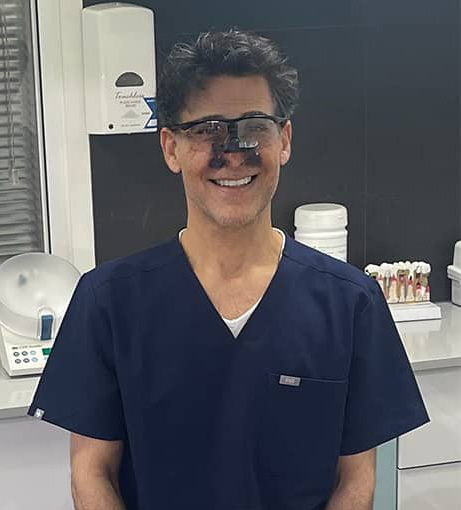
Crown and bridge treatments at London Specialist Dentist are provided under the clinical leadership of Dr. Nico Kamosi, a specialist clinician with extensive training in periodontology, implantology, prosthodontics and orhtodonitcs.
Dr. Kamosi obtained his Doctor of Dental Surgery degree from the Dental University of Sweden in 1995 and later completed recognised specialist training in periodontology in the UK. He subsequently obtained an MSc in Oral Implantology from the Eastman Postgraduate Institute at UCL and completed a Master of Clinical Dentistry in Prosthodontics at King’s College London.
His multidisciplinary background supports a restorative approach that prioritises:
- Conservative and atraumatic tooth preparation
- Evidence-based material selection and biomechanics
- Careful assessment of functional bite and occlusion
- Long-term biological and functional outcomes of full-mouth rehabilitation
In addition to private practice, Dr. Kamosi has been holding academic roles, including clinical consultancy in oral function and implantology at the University of Amsterdam and senior clinical teaching in periodontology at King’s College London. He is listed on the Specialist Register of the General Dental Council in the UK, Sweden, and Norway.
Why Specialist-Led Crown Treatment Matters
In order to achieve long term success and durability of dental crowns, it is essential that the diagnosis, material selection, and execution of crown fabrication are carried out with a high level of expertise and experience, supported by close collaboration between the dental technician and the specialist dentist.
A specialist trained dentist has advanced expertise in managing compromised bite, occlusion, and dentition. This includes cases where there is a need to choose between implant supported crowns and bridges, or where the bite requires modification, such as reorganised occlusion rather than conformative occlusion.
Specialist involvement is also crucial when there are high aesthetic demands in the anterior region, particularly when minimally invasive dentistry is preferred over more traumatic treatment approaches.
Overall, a specialist led holistic approach to conservative and reconstructive dentistry is planned and delivered based on each individual patient’s needs, with the aim of achieving the highest quality crowns, long term prognosis, and clinical success.
Dr. Nico Kamosi
Dr. Nico Kamosi
Specialist Periodontist, Implantologist, Prosthodontist, Holistic and Biological Dentist
TDL. DDS. (Swe.), MSc.Perio.(Eng.),
MClinDent.Perio.(Eng.), MSc.Imp.Dent.(Eng.),
Dip.Aesth.Med. (Eng.), MClinDent.Prosth.(Eng.),
Cert., Dip.DHSLM.(RCS.Eng.), Cert.Orth.(Eng.), Cert.Law (Eng.), AIAOMT
Accredited member of IAOMT, SMART Certified
Member of AACD, EFP, AAP, ESCI, IAOMT
