
Last Updated on March 12, 2026 by Dr. Nico Kamosi
When people first hear the phrase “biological dentistry” or “holistic dentistry” they are often surprised — and understandably unsure how to interpret it. Some assume it is something alternative or experimental. Others wonder whether it is simply conventional dentistry with a different name.
In fact, biological dentistry is a well-grounded healthcare philosophy that treats your teeth and your general health as one connected system — not two separate concerns. It deals with the teeth, the gum tissue, and the structures around them, while simultaneously addressing the systemic health issues that arise from — or contribute to — dental disease. More importantly, it shifts our focus from treating problems late, to understanding and preventing them early.
IS YOUR MOUTH REALLY CONNECTED TO THE REST OF YOUR BODY?
Yes — and the evidence for this has been building for decades.
The mouth is a gateway to the rest of the body: to the stomach, the intestines, the lungs, the heart, and other vital organs. We have known for years that periodontal disease — gum disease — is closely linked and correlated to a wide range of systemic conditions: diabetes, cardiovascular disease, adverse pregnancy outcomes, pancreatic health, Alzheimer’s disease, and other conditions that are either well-established in the medical literature, or still emerging.
The reason is inflammation. The bacteria that cause gum disease, along with their byproducts and the biological toxins they produce, enter the bloodstream through inflamed gum tissue. From there, they travel through the vascular system and burden both the immune system and the body’s wider health defences. This is not a theory — it is a well-evidenced biological pathway that research continues to strengthen.
A 2025 study published in Scientific Reports, drawing on data from nearly 14,000 adults, confirmed statistically significant associations between periodontitis and both diabetes and hypertension. A separate 2025 review in Cureus mapped the precise mechanisms: oral bacteria triggering systemic inflammation, disrupting the lining of blood vessels, and interfering with immune regulation throughout the body. Emerging research has even detected Porphyromonas gingivalis — a key periodontal pathogen — in brain tissue, pointing to a possible role in the development and progression of Alzheimer’s disease.
This is why biological dentistry matters. Understanding these connections is not just academically interesting — it changes how we examine, diagnose, and care for our patients.
From Clinical Practice
In my clinical experience, I have encountered patients with uncontrolled glycaemic metabolism who were simultaneously suffering from severe and progressive periodontal disease. These patients were treated comprehensively and monitored closely at regular reassessment intervals. Infected root canals were identified and treated, and the sources of uncontrolled oral infection were systematically eliminated as part of a carefully designed, staged treatment plan.
What followed was remarkable. At each reassessment, patients presented with progressively reduced blood sugar levels alongside a measurable reduction in the severity and extent of their periodontal disease. By the end of their treatment journey, it was not only the clinical parameters that had improved — their families expressed deep satisfaction about the patients’ overall health, their mobility, their memory, and the quality of their daily lives.
This is the oral-systemic connection in practice. Not in a journal. In a patient’s life.
HOW IS BIOLOGICAL DENTISTRY DIFFERENT FROM CONVENTIONAL DENTISTRY?
Conventional dentistry does important and necessary work. It diagnoses and treats fractured teeth, decay and cavities, root canal infections, and gum disease. A biological dentist takes one step further — asking not just what needs treating, but what the patient’s overall health status is, and whether the mouth is contributing to or reflecting problems elsewhere in the body.
Consider a patient who presents with poorly controlled blood sugar, insulin resistance, nutritional deficiencies, hormonal imbalance — hypothyroidism, hyperparathyroidism — or signs of a reduced or dysregulated immune response. A biological dentist has a duty of care to investigate whether there are root causes within the mouth: an undetected infected root canal, uncontrolled gum disease, hidden cavities that have gone undiagnosed.
Equally, for a patient seeking dental implants, we have a responsibility to assess bone density, healing capacity, and overall health status before we proceed with bone augmentation or implant placement. These are not optional considerations — they are essential to achieving a safe and lasting outcome.
We do not treat patients as though they are simply carrying teeth. They are whole people — and that shapes everything about how we approach their care.
WHAT MATERIALS AND TECHNIQUES DOES A BIOLOGICAL DENTIST USE?
Biocompatible, Mercury-Free Restorations
We have not used mercury amalgam for decades. For cavities — small, medium, or large — we use BPA-free, UDMA, TEGDMA, and nano-ceramic composite materials. For crowns and bridges, we use all-ceramic, metal-free restorations: ideally zirconia-based, Emax, or layered zirconia. For dental implants, we use ceramic zirconia implants in the majority of appropriate cases — a material that is not only metal-free, but has been rigorously tested and shown to be highly biocompatible, with a lower propensity for bacterial plaque attachment than titanium, and superior soft tissue integration around the implant.
For patients with known or suspected metal sensitivities, we offer MELISA biocompatibility testing — a blood test that identifies whether the immune system has been sensitised to specific metals — before any implant is placed.
Regenerative and Minimally Invasive Techniques
Although the body has a remarkable capacity to heal itself, we support that process with evidence-based, adjunctive biological approaches. Leucocyte Platelet-Rich Fibrin — L-PRF — is derived from the patient’s own blood and concentrated using a centrifuge. It contains up to 50% lymphocytes, white cells, and growth factors that enhance both soft and hard tissue regeneration. This is what we call autologous platelet concentration, or APC — the body healing itself, guided by science.
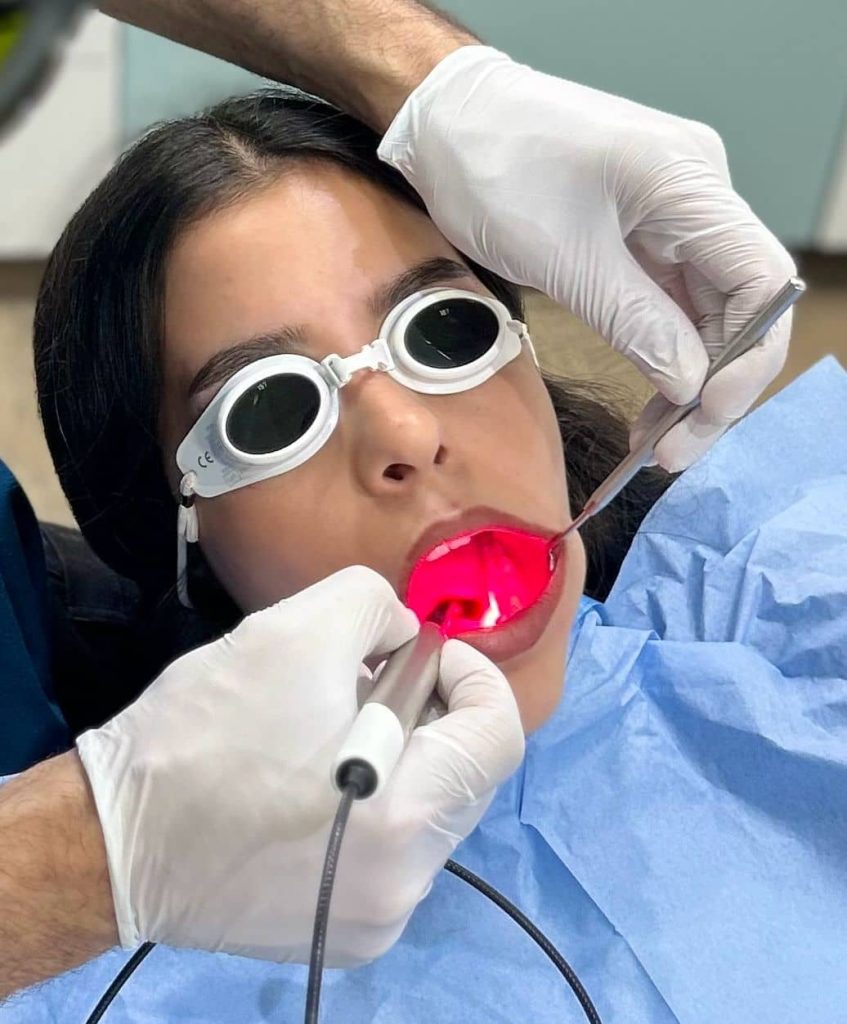
We also use ozone therapy as a non-antibiotic antimicrobial disinfection protocol — eliminating harmful bacteria without the systemic burden of antibiotics. And we implement photobiomodulation and low-level laser therapy: reducing inflammation, stimulating the ATP pathway, and supporting cellular repair. These are not experimental treatments. They have an established evidence base in oncology, autoimmune disease management, and care of immunocompromised patients.
Nutrition and Lifestyle as Part of Treatment
Uncontrolled blood sugar, excess refined carbohydrates, sugar, gluten, dairy, and other pro-inflammatory dietary factors all contribute to the body’s systemic inflammatory burden — and indirectly to gum disease, insulin resistance, cardiovascular risk, and hypertension. Nutritional and lifestyle guidance is an integral part of how we treat our patients, not an afterthought. We also collaborate with nutritionists, functional medicine doctors, and other health professionals as a team — because no single clinician can address every dimension of a patient’s health alone.
IS BIOLOGICAL DENTISTRY SAFE — OR IS IT JUST ALTERNATIVE MEDICINE?
This is a fair question, and it is important to answer it clearly.
Biological dentistry is not a DIY approach to dental care. It is not anti-science. It is not to be confused or conflated with unproven alternative therapies. We follow peer-reviewed evidence, randomised controlled trials, and established clinical guidelines. Our philosophy is to practise based on the science — and to remain genuinely open-minded as new evidence emerges, rather than dismissing it because it challenges convention.
L-PRF is well-evidenced. Laser-assisted periodontal therapy has a growing and robust published evidence base. Zirconia implants have been rigorously tested as a biomaterial and shown to be at least as biocompatible as titanium — and in many respects more so. We regard biological dentistry as a genuinely medical-dental, multidisciplinary field. Dentistry and medicine are not separate disciplines — the science increasingly shows they are deeply interconnected, and our practice reflects that.
On the question of mercury: the European Union banned dental amalgam for all patients from January 2025, citing mercury as a potent neurotoxin with demonstrated effects on the brain, kidneys, and immune system. The UK has not yet followed with a formal ban — but biological dentistry has operated on mercury-free principles for years, not in defiance of evidence, but guided by it.
WHAT CAN I EXPECT AT MY FIRST BIOLOGICAL DENTISTRY CONSULTATION?
When you attend London Specialist Dentists, you can expect a comprehensive full-mouth consultation — one that looks at far more than your teeth.
We conduct a thorough dental and periodontal assessment. Where clinically indicated, we use CBCT — cone beam 3D imaging — which reveals periapical and periodontal disease that two-dimensional X-rays routinely miss. We look at your diet patterns, your sleep patterns, what materials are already present in your mouth, and what environmental or lifestyle factors may be influencing your oral and general health. If needed, we will advise you to consult with your GP or other specialists, and we work collaboratively with other health professionals when this serves the patient’s best interest.
The goal is not simply to fix today’s problem. It is to understand your oral environment — and to understand you — well enough to support and protect your health for the long term.
THE BIGGER PICTURE: WHY LONG-TERM THINKING CHANGES EVERYTHING
Biological dentistry, whether in its short-term interventions or its long-term treatment planning, is about going one extra mile at every stage — in the patient’s best interest. It is about making a meaningful difference using the best available knowledge, the best available materials, and the best available techniques — at every appointment, for every patient.
Both short-term and long-term, our aim is the most optimal result. That requires the right equipment, the right materials, the right protocols — and a genuine commitment to treating the person, not just the tooth.
If you have any questions about biological dentistry, safe mercury amalgam removal, ceramic zirconia implants, gum disease, or your oral health more broadly, please do not hesitate to get in touch with us.
Supporting Research
Indramohan J et al. Scientific Reports, March 2025. Investigating the link between oral health conditions and systemic diseases.
Scientific Reports, April 2025. The interconnection of oral and systemic health.
Cureus, February 2025. The oral microbiome and systemic health: bridging the gap between dentistry and medicine.
Hensel ALJ et al. Frontiers in Oral Health, May 2024. Biopsychosocial factors in oral and systemic diseases.
Journal of Dental and Advanced Clinical Sciences, November 2025. Oral-systemic connection: a narrative review.
European Commission / IAOMT. EU dental amalgam ban, effective January 2025.
Dr. Nico Kamosi
Dr. Nico Kamosi
Specialist Periodontist, Implantologist, Prosthodontist, Holistic and Biological Dentist
TDL. DDS. (Swe.), MSc.Perio.(Eng.),
MClinDent.Perio.(Eng.), MSc.Imp.Dent.(Eng.),
Dip.Aesth.Med. (Eng.), MClinDent.Prosth.(Eng.),
Cert., Dip.DHSLM.(RCS.Eng.), Cert.Orth.(Eng.), Cert.Law (Eng.), AIAOMT
Accredited member of IAOMT, SMART Certified
Member of AACD, EFP, AAP, ESCI, IAOMT
